Deterministic operating envelope
Execute time-bound sensing, control and protection against a locally available configuration. Reject commands that are late, unauthenticated or incompatible with current physical state.
CognoSys engineers connected systems in which devices act locally, cloud services coordinate globally and people retain clear authority. The design begins with physical consequence, bounded compute and interrupted networks—not with an assumption of permanent cloud control.
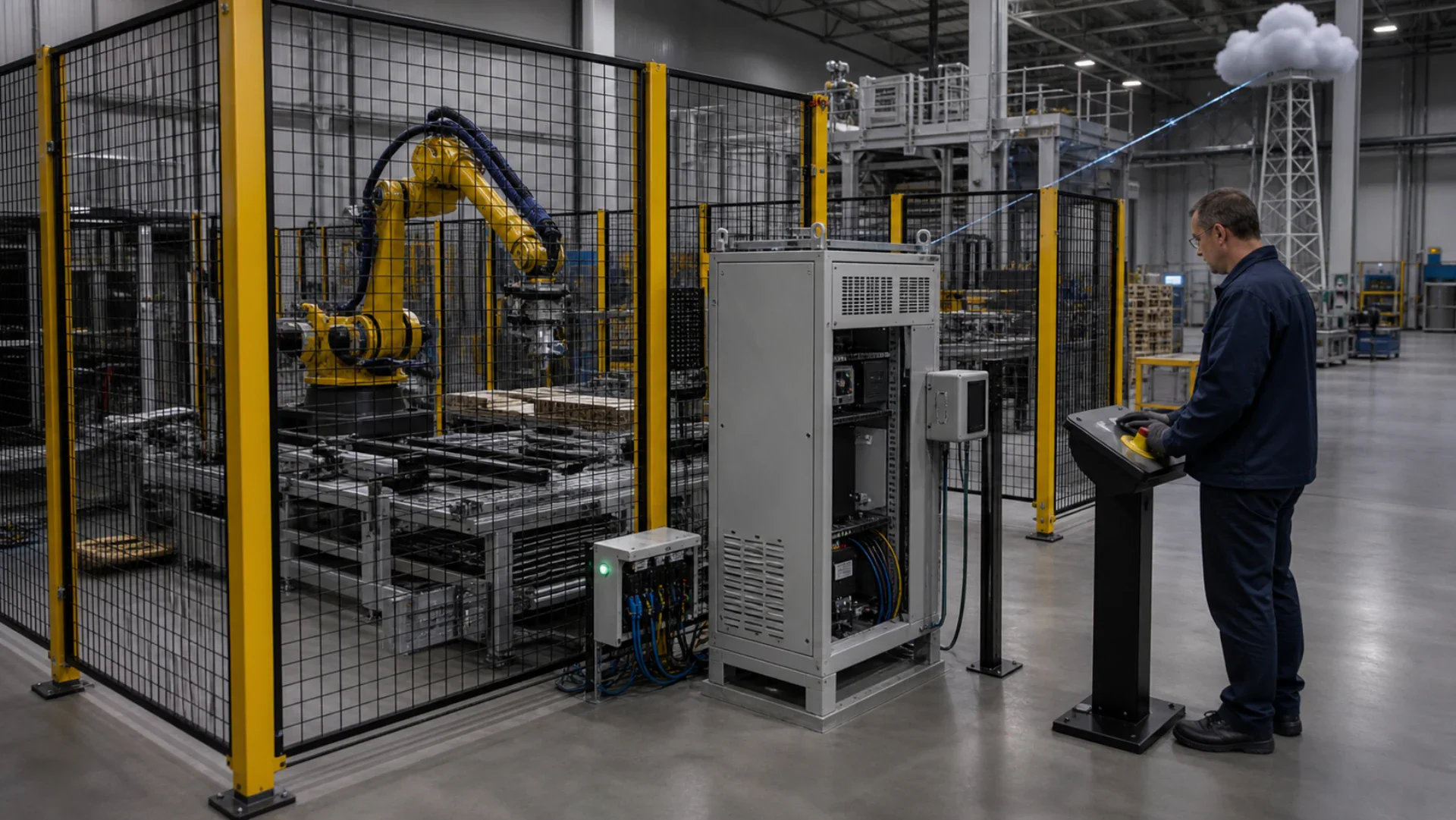
Control belongs close to the consequence. A device or cell can own timing-sensitive motion, interlocks and the safe local state; the cloud can own fleet policy, workload distribution, model promotion and long-horizon optimization. The boundary is explicit enough that neither side waits indefinitely for the other.
Execute time-bound sensing, control and protection against a locally available configuration. Reject commands that are late, unauthenticated or incompatible with current physical state.
Distribute policy, software, models and work; aggregate evidence; plan capacity; and compare behavior across devices without becoming a single point of physical control.
Operators can pause, isolate, recover or transfer control through a defined authority model. Overrides are visible, time-bounded where appropriate and preserved as evidence.
A connected device is not trusted merely because it is on a private network. Provisioning establishes hardware or workload identity, ownership, environment and permitted capability. Commands carry issuer, target, intent, expiry and correlation context; the edge validates them again against current state before execution.
Command delivery is idempotent where an operation can safely be repeated. Sequence numbers, correlation identifiers and deduplication windows prevent a reconnect from replaying stale movement or configuration instructions.
The edge maintains the minimum state, policy and work queue needed for its approved offline envelope. Connectivity loss changes what the system may do: some tasks continue, some enter a reduced mode and some stop safely.
Retain required configuration, commands, results and telemetry within storage limits, priority rules and retention windows.
Use last-known-good policy only for explicitly permitted decisions; expire authority rather than allowing indefinite autonomous drift.
Resume from checkpoints, deduplicate messages and distinguish event time from arrival time when delayed evidence reaches the cloud.
Compare cloud intent with device-observed state and route conflicts through policy or human review instead of blind overwrite.
Edge AI selection starts with the decision deadline, sensor quality, compute budget, power, heat and acceptable fallback. Models are packaged with compatible runtimes, pre-processing and confidence policy. Work can be partitioned so immediate inference stays local while expensive training, aggregation or secondary analysis runs centrally.
Software, firmware, models and configuration follow separate versioned channels because they have different risk and rollback behavior. Packages are signed, verified before activation and checked for hardware and dependency compatibility.
Move from lab and simulated workloads to canary devices, representative sites and wider fleet groups with explicit health gates.
Download and verify independently, activate at a safe boundary, retain the prior slot and report the exact active version.
Use boot health, process health and operating signals to return to a compatible state when the new release cannot complete its checks.
Safety-relevant limits remain enforceable independently of cloud services and nonessential application logic. Watchdogs, interlocks, command expiry, rate bounds and operating envelopes constrain action. A fault transitions into a named state with a known recovery authority.
Separate device, cell and fleet failure so a bad workload or configuration cannot cascade without a deliberate boundary crossing.
Define the safest achievable state for loss of control, sensor disagreement, compute exhaustion and communication failure.
Make emergency stop, local control and maintenance modes direct, observable and independent of normal orchestration.
Require state checks, fault acknowledgement and synchronization before a device rejoins automated fleet operation.
Fleet telemetry should identify version, health, resource pressure, connectivity and recent commands without collecting unnecessary raw data. Diagnostic bundles are bounded, privacy-aware and correlated. Replacement, re-enrollment and decommissioning remove obsolete trust as carefully as provisioning creates it.