Establish hardware and software identity.
Bind approved firmware, configuration and credentials to the device lifecycle, including provisioning, rotation and retirement.
Engineer device identity, local decisions, command and telemetry paths, degraded operation, update governance and human supervision as one operating system.
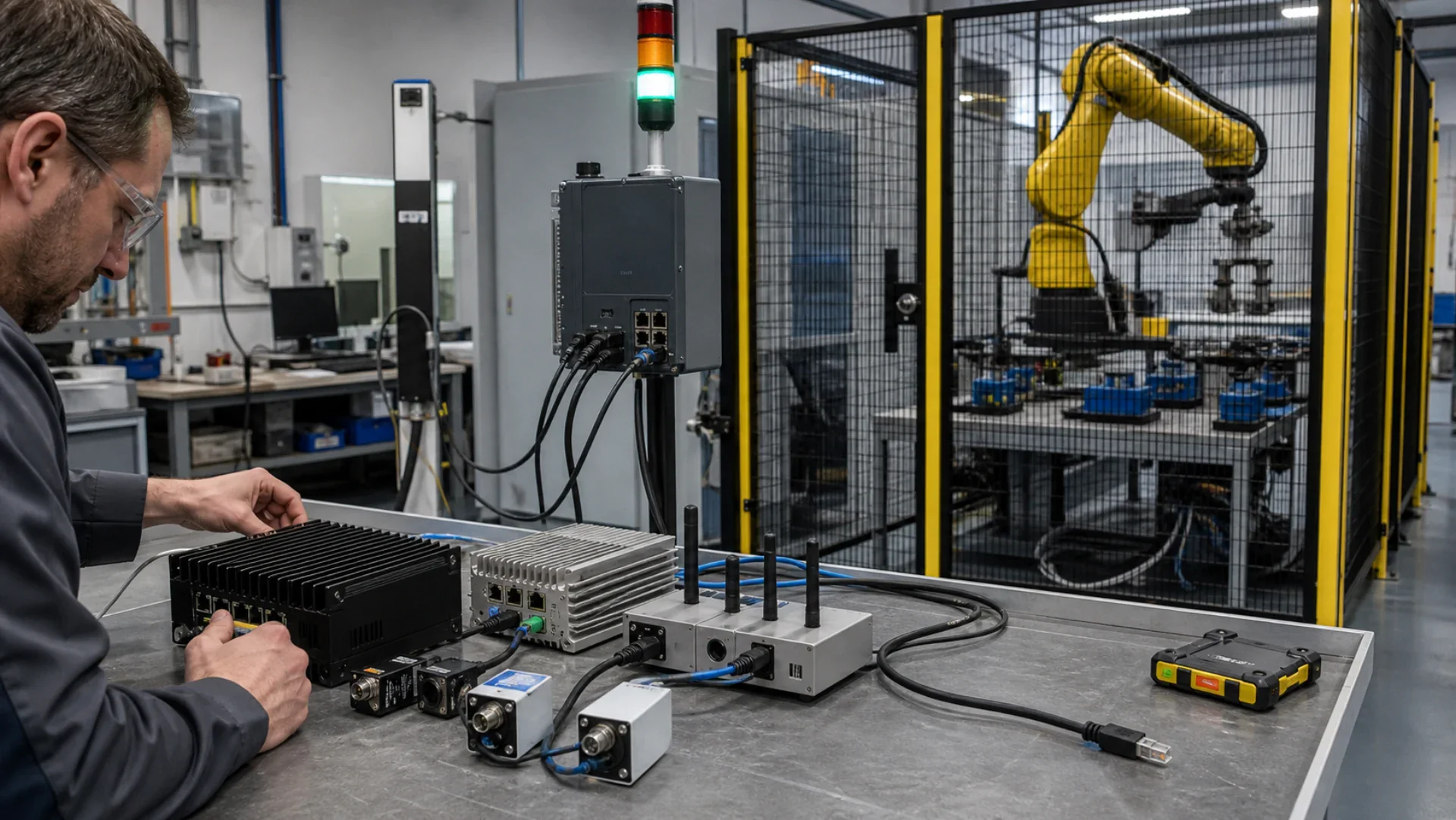
Robotics and edge systems face device diversity, timing sensitivity, intermittent connectivity, constrained resources and physical consequences. The design must state which decisions remain local, what central services control, how people supervise the system, and what safe behavior means when dependencies fail.
Each layer has a defined authority, latency budget, data responsibility and failure behavior.
Bind approved firmware, configuration and credentials to the device lifecycle, including provisioning, rotation and retirement.
Run bounded local logic, state and buffering where timing, connectivity or data volume makes a central round trip unsuitable.
Manage policy, commands, events, telemetry, updates and integration through explicit APIs and asynchronous paths.
Give operators current state, authority boundaries, intervention controls and evidence of what the physical system did.
The chain keeps authorization and feedback visible across device, edge and platform boundaries.
A credible edge architecture avoids treating every interaction as the same request. Commands need authority and acknowledgement; events need ordering and idempotency; telemetry needs bounded volume; updates need staged rollout and recovery.
Safety, reliability and security depend on the specific physical system. The software architecture supports those responsibilities but does not replace the required domain engineering.
Define which decisions continue offline, for how long, with which inputs and with which physical constraints.
Stage updates, validate compatibility, observe rollout health and maintain a recovery path for devices that diverge.
Make communication loss, stale state, device faults and operator intervention explicit operating modes.
Edge engineering is a partitioning discipline. CognoSys determines which signals are processed on the device, at a site gateway or in a regional or central platform, then defines how state, models, policy and evidence move between those tiers without assuming continuous connectivity.
Filter, aggregate or infer locally where raw video, audio or industrial telemetry is too large, sensitive or time-critical for continuous upstream transfer.
Keep deterministic device loops within their appropriate control boundary while the platform coordinates orders, policy, fleet state and human decisions.
Select representative evidence, manage dataset and model versions, validate against device classes, and stage promotion with monitoring and rollback.
Expose device health, connectivity, command status and acknowledgement; distinguish advisory actions from remote control and preserve local limits during intervention.
CognoSys designs the platform, integration, identity, telemetry, workflow and update paths in partnership with the system owner and qualified mechanical, electrical and safety specialists. Hardware limits, hazard analysis, site procedure and human training inform software authority from the beginning.
Bring the devices, sites, timing constraints, connectivity model, local decisions, commands, telemetry, update path and operator responsibilities. We will frame the edge-to-platform architecture.